Live camera views
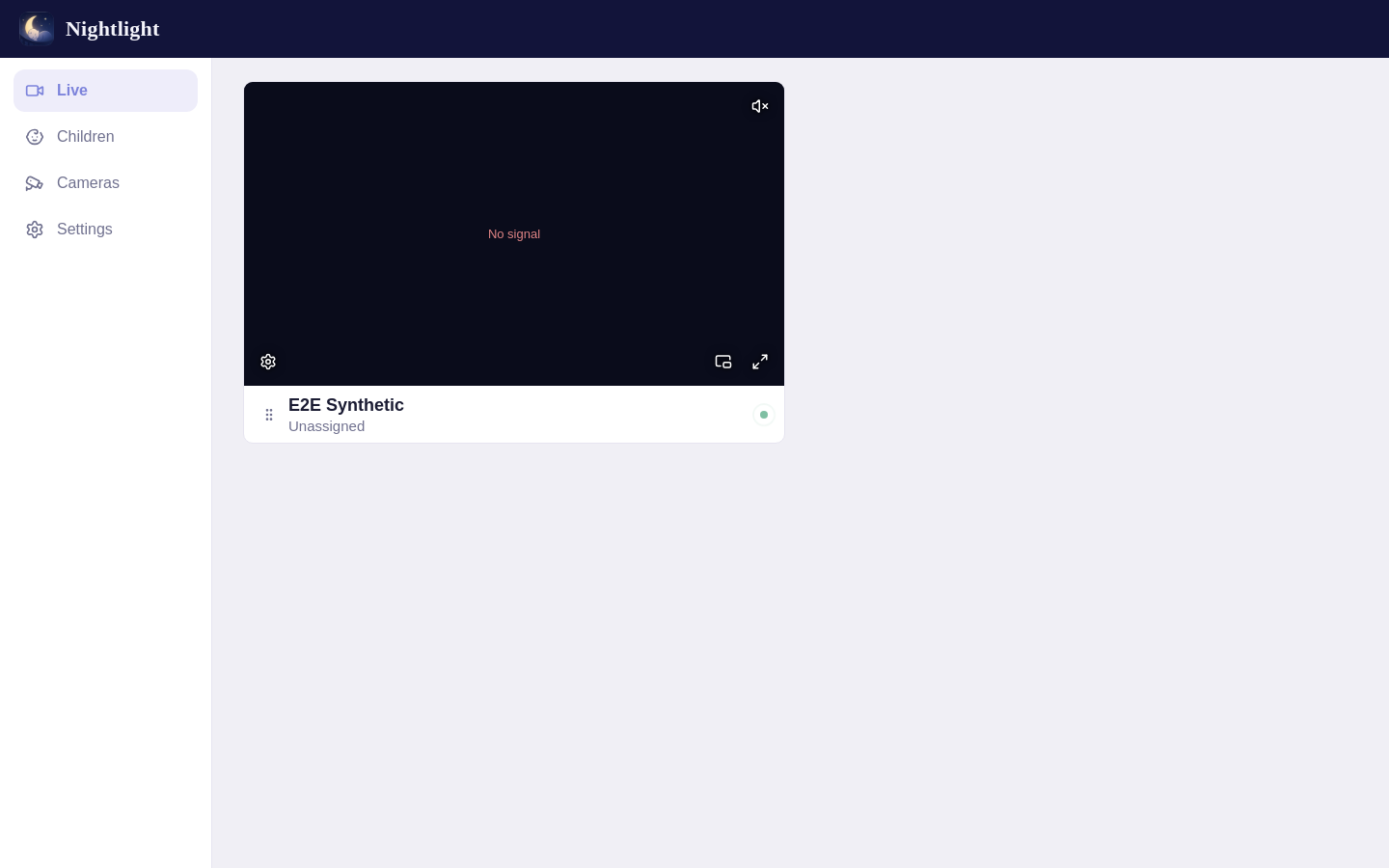
Watch low-latency live video from your local cameras, grouped by child. Keep the rooms that matter together in one view.
Live video & audio Nightlight.
View on GitHub
Nightlight.
View on GitHub
A SELF-HOSTED BABY MONITOR
Watch and listen to your local cameras, save recordings, and review estimated sleep patterns. Nightlight runs on your own hardware and works in your browser.
FEATURES
Watch low-latency live video from your local cameras, grouped by child. Keep the rooms that matter together in one view.
Live video & audioListen in while you unwind. Companion mobile apps add background listening, with motion and sound notifications available to configure.
Listening & optional alertsSave a recording, revisit a wake-up, and explore estimated sleep patterns. Review and correct sleep estimates in the morning.
Recordings & sleep insightsSCREENSHOTS
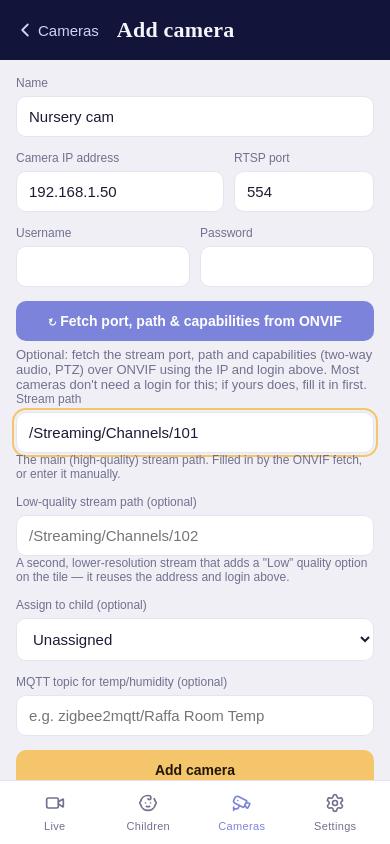
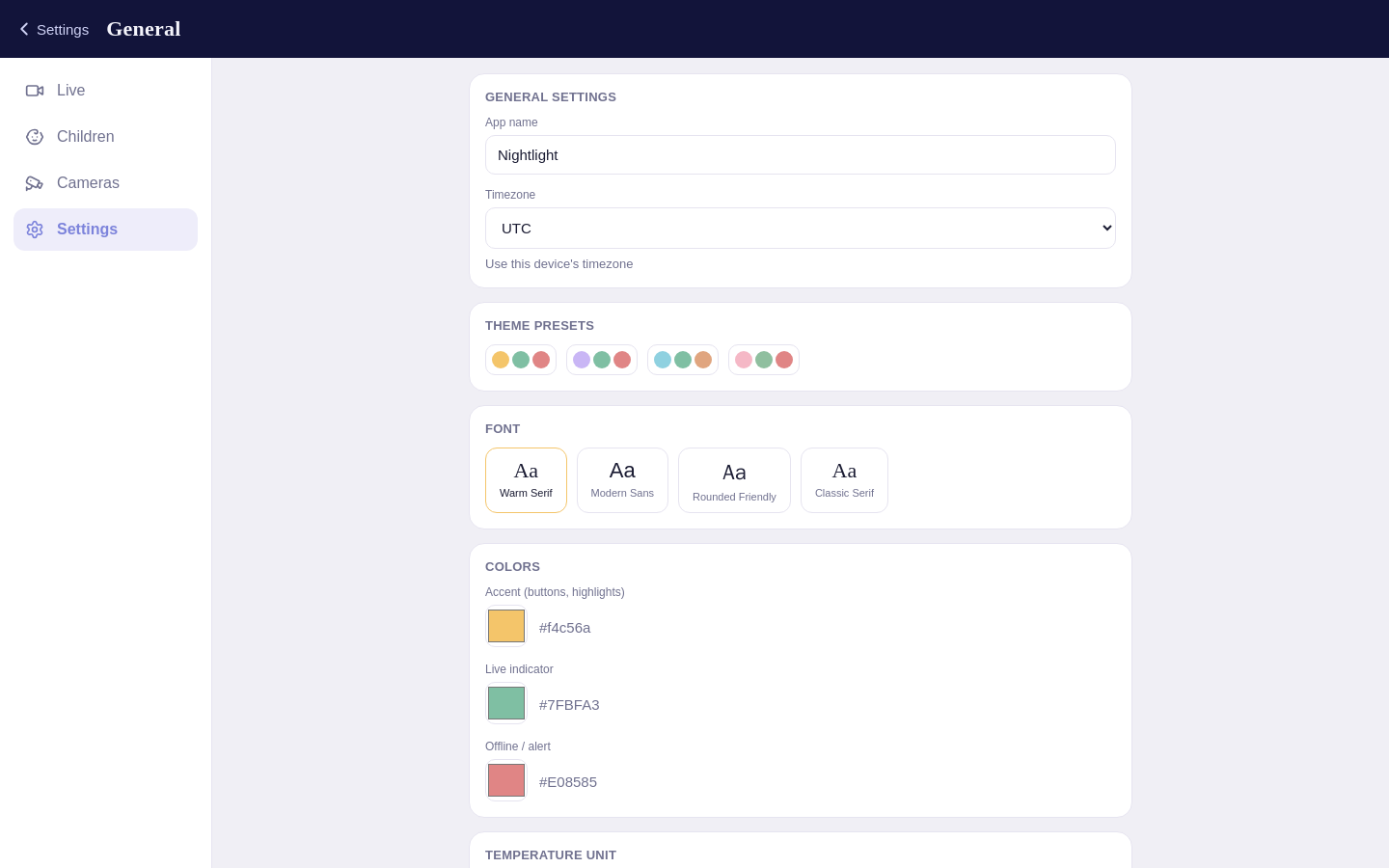
Desktop and mobile web views.
Select a screenshot to see it at full size.
SELF-HOSTING
Nightlight connects to the cameras you already have and brings them into your browser. The core app runs on your network, with your footage and settings stored on your server.
Read the technical overviewRemote access is optional and needs setup. Notification providers may use external services.
SETUP
You’ll need a compatible camera
and an always-on Docker host.
You'll need a camera with a local RTSP stream. ONVIF support can make adding it a little easier.
Run the Docker container on your Linux server or Unraid box, with persistent storage for your data.
Create your account, add cameras, and check your audio, timezone and any alerts you choose to enable.
Use an always-on Linux server with Docker installed, on the same local network as your cameras. Both amd64 and arm64 systems are supported. Choose this method or the Unraid option below.
Replace /path/to/your/data with an absolute folder path on your server. This stores your database and, by default, recordings, so allow room for video and back up this folder. Set PUID and PGID to the folder owner's IDs; find them with id your_username. The values below, 99 and 100, are the usual Unraid defaults.
Run this in your server's terminal after changing the data path and user IDs. You can replace UTC with your timezone, such as Australia/Sydney; this controls log timestamps.
docker run -d \
  --name nightlight \
  --network host \
  --restart unless-stopped \
  --log-opt max-size=10m \
  --log-opt max-file=3 \
  --stop-timeout 30 \
  -e PUID=99 \
  -e PGID=100 \
  -e TZ=UTC \
  -v /path/to/your/data:/app/data \
  sauso/nightlight:latest
Host networking shares your server's IP and ports, including the web interface on port 4000. Keep the log limits and 30-second stop timeout: they limit Docker log growth and give recordings time to finish during shutdown.
From a trusted device on the same network, open http://<server-ip>:4000, replacing <server-ip> with your server's local IP address. Create the first admin account before making the installation accessible to anyone else.
Use the Children tab to add a child, then Cameras → Add camera. Enter the camera's IP and credentials. Use ONVIF to fetch connection details if supported, or enter its RTSP port and stream path from the camera's manual. Assign the camera to a child.
Confirm live video and audio work on the devices you'll use. Set the app's timezone in Settings, review recording storage and retention, and configure and test any motion or sound alerts you enable. These instructions set up local access; remote access needs additional configuration.
Alternatively, install using the included Docker template. Open the Unraid Terminal and run:
mkdir -p /boot/config/plugins/dockerMan/templates-user
wget -O /boot/config/plugins/dockerMan/templates-user/my-nightlight.xml \
  https://raw.githubusercontent.com/sauso/nightlight/main/unraid-template.xml
Go to Docker → Add Container, select nightlight from the Template dropdown, and check the Data Directory (default: /mnt/user/appdata/nightlight). Keep host networking for this setup, then select Apply. Open http://<server-ip>:4000 and follow steps 3–5 above.
You run Nightlight on your own always-on computer or server using Docker. You manage the installation, storage, updates and backups. This website is an introduction to the app; your camera dashboard runs on your own installation.
Nightlight is open source under the MIT license, with no Nightlight subscription. You provide the cameras, server and storage. Optional services, such as some notification providers, may have their own costs.
Your cameras need to expose a local RTSP stream. ONVIF can help discover stream settings and supported controls. Camera codecs and browser support vary, so check the camera guide and test your setup before depending on it.
Yes. Nightlight has a mobile-friendly web interface and can be added to your home screen. Companion Android and iOS apps offer additional native features. Background audio and notifications have platform-specific requirements; see the mobile app guide.
Local network use is the default. Remote access is possible with additional secure networking setup. Follow the remote access instructions rather than exposing an unconfigured installation to the internet.
No. Nightlight is a convenience tool and is not a substitute for adult supervision. Streams, networks and notifications can fail. Sleep insights are estimates, not medical measurements or advice.
If you find Nightlight useful, you can support its development with a donation.
Donate via PayPal